Manufacturing companies can operate much more cost-effectively if they reduce formal organizational overhead. This applies, for example, to the procurement and replenishment of tools from Tool manufacturers. The organization of tool regrinding by external service providers is also one of the internal processes that has traditionally been time-consuming.
Christoph Zoller, managing director of E. Zoller GmbH & Co. KG in Pleidelsheim—a family-owned technology company specializing in the cost-effective handling of cutting tools—comments: “With our software modules for the ordering system and regrinding orders in ZOLLER’s TMS Tool Management Solutions, we ensure significantly faster, simpler, and also safe, error-free processes in tool procurement. This reduces the effort and costs associated with unproductive activities. As a result, companies can operate more profitably.”
Exact, Complete Tool Data
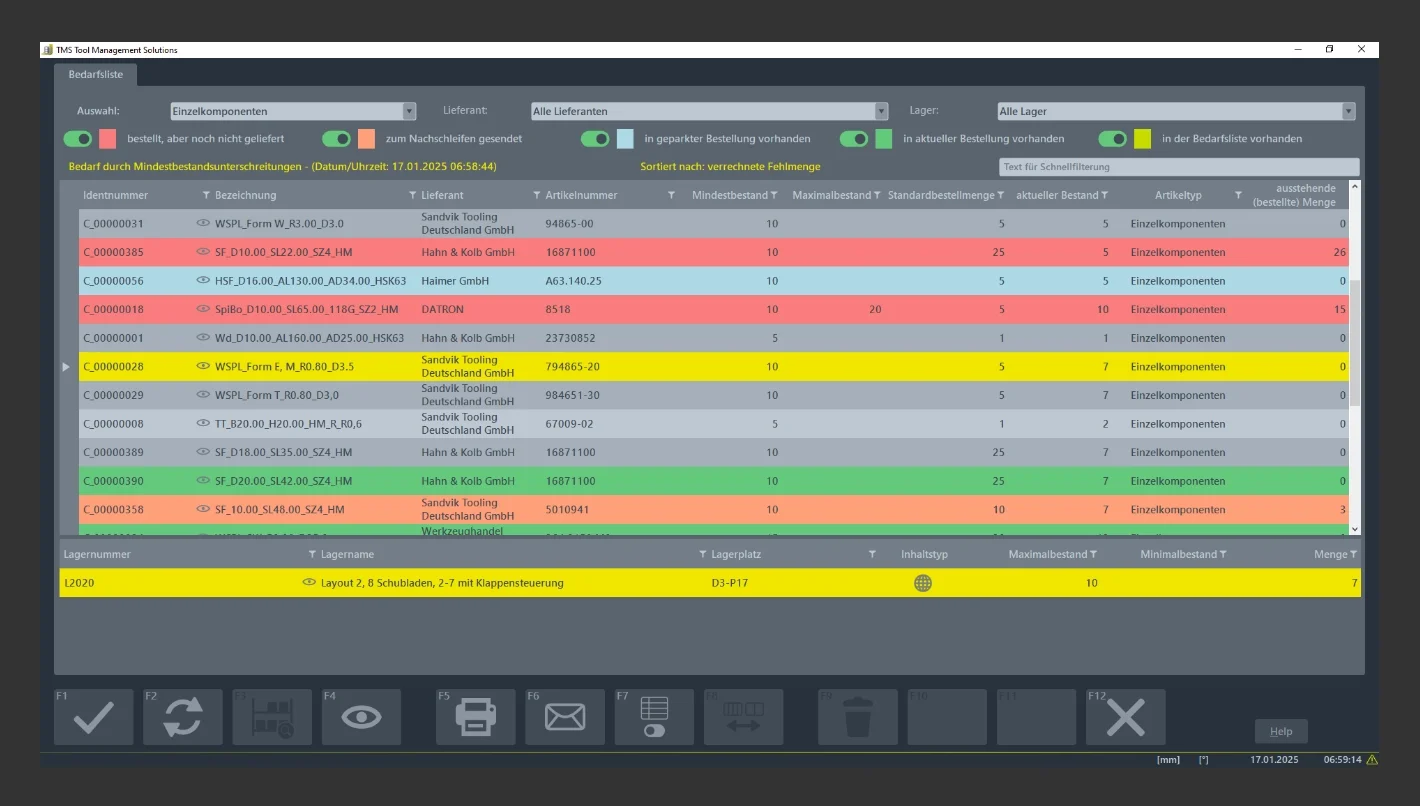
Robin Bender, project manager for the TMS Tool Management Solutions software at ZOLLER, highlights a key advantage of the Ordering System and Regrinding Orders modules: “In the ZOLLER TMS Tool Management Solutions system, actual stock levels are continuously updated, and all tool data is available in full. That’s why orders and regrinding orders processed using the Ordering System and Regrinding Orders software modules are reliable and always accurate.” There is no need for time-consuming follow-up inquiries to different areas. This applies, for example, to the tool warehouse regarding stock levels and to tool preparation regarding correct designations for components. Robin Bender emphasizes: “The ordering system and Regrinding Orders software modules automatically retrieve item master data, stock levels, minimum stock levels, and—where stored—supplier addresses, costs, and lead times from the TMS Tool Management Solutions software.”
In addition, using the software module, lists of tools to be procured can be generated at any time with a keystroke based on stored minimum stock levels. After a selection of individual tools or an entire list, the Ordering System and Regrinding Orders software modules automatically generate purchase orders for suppliers or, optionally, orders for external regrinding shops. Only a cost center needs to be specified.
Flexibly Configurable
The Ordering System and Regrinding Orders software module can be simply and easily adjusted to the individual formal specifications of different manufacturing facilities. For example, the formats of lists of tools to be procured, their contents, and the dates or events for automatic generation of lists can be freely configured. For example, lists can be generated and displayed at set intervals—daily, weekly—or when stock levels fall below minimum stock thresholds. In addition, additional lists of tools to be procured or re-sharpened can be manually generated and displayed at any time. Further criteria can be specified for this purpose—for example, the type of tools and cost centers within the company.
For purchase orders to be output automatically, operator’s personnel can specify custom formats for emails, printing templates, and data records. They can also freely determine the contents of the purchase orders. For example, in addition to internal designations and part numbers, designations and order numbers, costs, and packaging units (if available in master data) from the respective manufacturers can be recorded in orders.
The “Ordering System and Regrinding Orders” software module also offers flexibility regarding the quantities of tools in stock within the ZOLLER TMS Tool Management Solutions software. If, for example, short-term fluctuations in production jobs result in additional demand for individual tools (beyond the stored minimum stock levels), specialists can manually create and submit additional orders. The stored minimum stock levels remain unchanged in this process.
For maximum flexibility, purchase orders can be created and saved initially until further criteria for dispatching an order are met. This allows manufacturing companies to take minimum order quantities into account, among other factors. They can also benefit from volume discounts and minimized packaging costs for consolidated shipments through orders with flexible scheduling.
Directly or through the sales department
When sending orders, manufacturing companies can choose the process that is optimal for their needs. On the one hand, the software module can send the entered and initiated orders to manufacturers as a data record, a printed document, or an email. Alternatively, it can generate data records with freely selectable content from the proposed orders and send them to a higher-level ERP system. Thus, the Ordering System and Regrinding Orders software modules are suitable, on the one hand, for small and medium-sized enterprises where individual specialists are in direct contact with manufacturers and regrinding companies. On the other hand, larger companies with separate technical and commercial organizational structures can also benefit. In the latter case, the commercial areas receive complete and, above all, reliably accurate information about the tools to be procured. This ensures carefully coordinated collaboration and maximum process reliability in internal workflows. Time-consuming, costly follow-up inquiries or even incorrect purchases are avoided.
Continuous Refreshes
Of course, the ordering system and regrinding orders enter goods receipts. In doing so, specialized staff can freely choose the subsequent internal workflows. For example, storage locations for incoming tools can be specified directly, or internal orders can be automatically generated for the departments that correspond to the tool warehouse—such as the tool warehouse—using the Storage Location Management software module. This applies to goods receipt following procurement from tool manufacturers as well as to repeated putting of tools into storage after they have been returned following regrinding. The ZOLLER TMS Tool Management Solutions software automatically refreshes the entire tool inventory to ensure that minimum stock levels are continuously and accurately monitored.




 Back to overview
