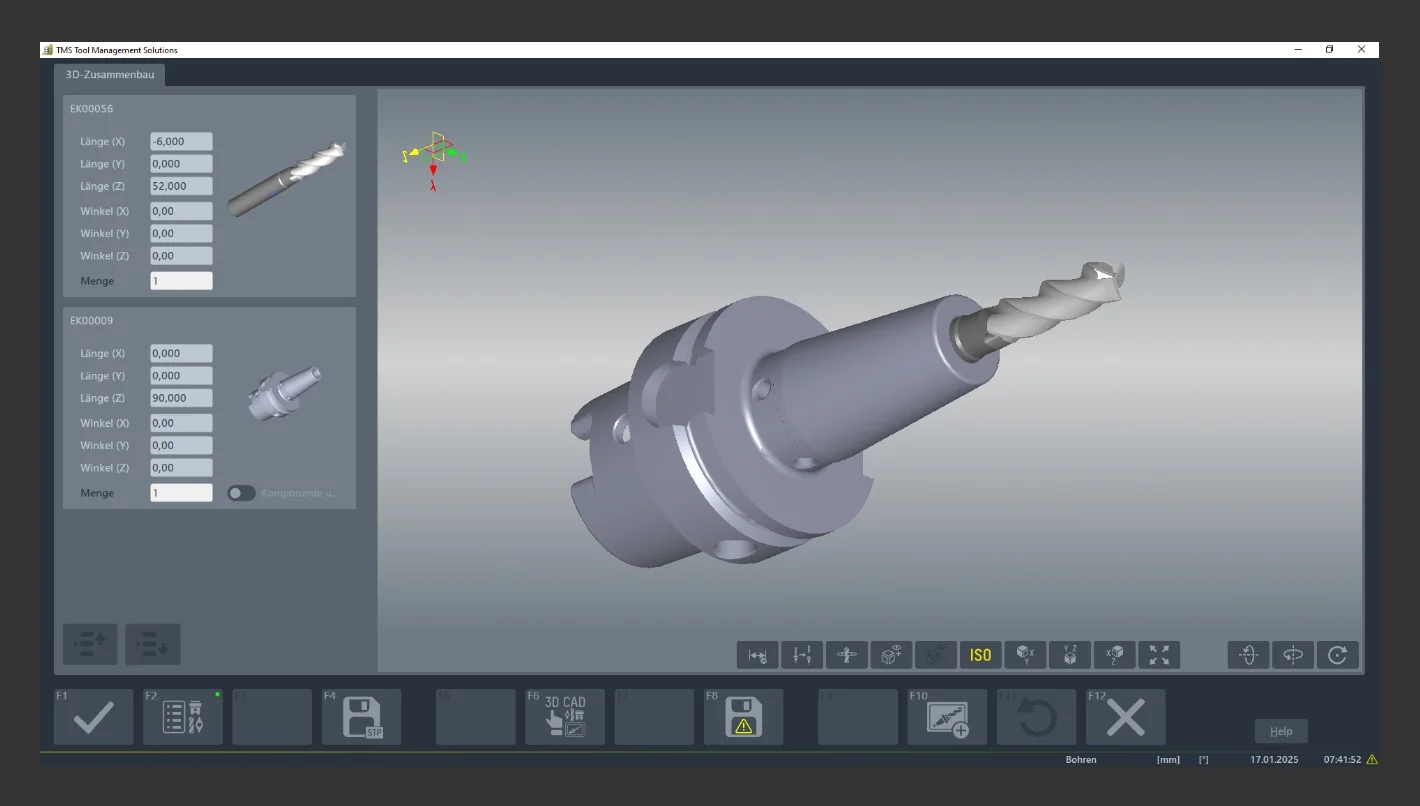
Complete tools consist of several components, mostly a tool holder, a tool support, and cutting elements. Most of the component data is available in the ZOLLER TMS Tool Management Solutions tool and tool data management system as master data and as 2D and 3D graphics. With the help of graphical assembly, complete tools can be generated quickly, easily, and reliably in a virtual manner, and data sets can be created and stored.
Combine only plausible components
To do this, work preparers first select the components from lists in the ZOLLER TMS Tool Management Solutions software. This is very easy thanks to a wide range of freely selectable search criteria. For example, components can be selected from symbolic graphics according to the machining process, the size and design of the tool holders (which correspond to ISO and DIN standards) or according to the cutting circle diameters required for the cutting edges.
The selectable cutting point coding function »is particularly useful for quick and reliable selection. It automatically checks the interfaces of the selected components. If the components comply with the DIN standard, the individual component library automatically filters out incompatible elements. For example, tools with Weldon shanks with a diameter of 10 mm can only be combined with tool holders of the same dimensions and designs. This ensures maximum process reliability when assembling complete tools. «
Once the appropriate individual components have been selected, a 2D graphic including dimensions is automatically generated. This includes, among other things, the lengths to which a shank must be fitted or screwed. In addition, the 2D graphic shows the assumed zero point of the complete tool, which is necessary for the adjustment and measurement of the NC program.
Photorealistic visualization
With the push of a button, volumetric models of the complete tools can be created. The generated 3D models are then stored in the ZOLLER »z.One« database. These graphics serve as the basis for programming in the respective CAD/CAM systems.
Many CAD/CAM systems can import this data via a ZOLLER interface. This means that manufacturing companies are independent of the choice of CAM system. They can also switch to other CAD/CAM software easily and without any problems.
Clear assignment
To enable work planners to quickly and easily recognize and determine the components required for assembly, the graphical assembly of the 3D models of the complete tools indicates the components in different colors. When the graphics are clicked, the software module highlights the corresponding components in the lists displayed in parallel. This allows assembly specialists to reliably identify these components and assemble them in a process-safe manner.
Individual expansion
Many manufacturing companies use individually designed tools. These can also be imported into the ZOLLER TMS Toolmanagement Solutions software. To do this, you only need to generate files in STEP format in the 3D CAD system and save them in the ZOLLER »z.One« database. Of course, the graphical assembly allows automatic assembly of complete tools of any type for different machining processes. In this way, abrasive wheel sets and non-rotationally symmetrical turning tools can be automatically assembled from selected components using the same processes as for milling and drilling tools. In the case of components designed and dimensioned strictly according to DIN standards, the software automatically checks whether the interfaces of the components fit together and whether the assembly is plausible. In this way, graphical assembly ensures that manufacturing companies work particularly efficiently and safely in the process of assembling complete tools. This shortens travel times, increases flexibility, and reduces costs.




 Back to overview
