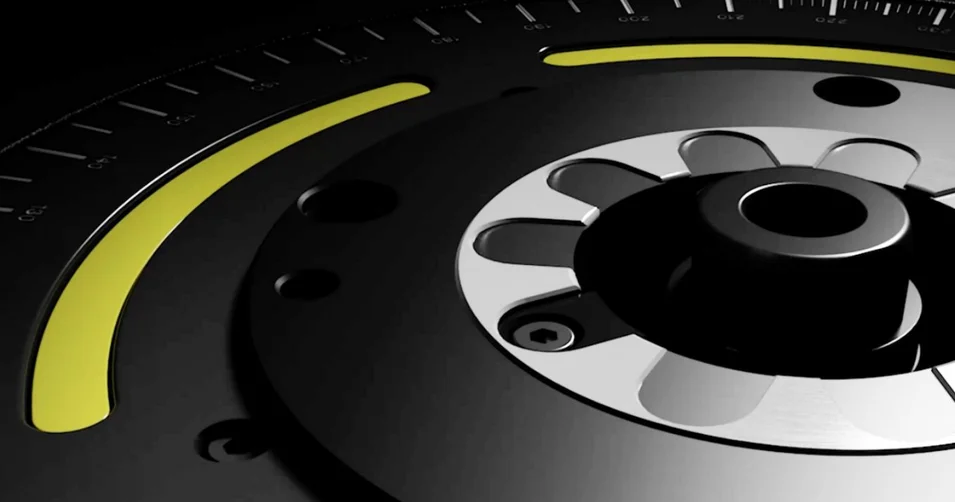



The ease of servicing is one of the main differences to other balancers on the market. Starting with the »twinPanel« safety cover of the »toolBalancer«. If a part comes loose during balancing or the disk ages due to contact with oil, the entire cover does not have to be replaced straight away. The cover is made up of two panels. This means you can only replace the inner disk. We therefore call it the "sacrificial disk". Furthermore, you have easy access to the spindle and all electronic components are carefully and safely installed in the control cabinet to ensure trouble-free operation. The position of the control cabinet, drives and sensors allows optimum accessibility for maintenance and service work.
A balanced tool assembly ensures longer tool life, less vibration, higher spindle speed, better part finish and, most importantly, longer spindle life.
Imbalance in a tool assembly creates excessive centrifugal forces that can damage the spindle bearings. Such damage reduces spindle life and can lead to costly unplanned downtime.
Cutting tools are sometimes asymmetrical, e.g. due to flattening on the shank (Weldon surface). Profile cutting tools can have an asymmetrical weight distribution. If such cutting tools are mounted in a balanced tool holder, this leads to an imbalance in the tool assembly. Collets, clamping nuts, stop screws, data chips etc. also contribute to the unbalance of the tool assembly. Once these other components are added to the toolholder assembly, the toolholder may need to be rebalanced to meet ISO balance specifications.
The following rule of thumb can serve as a guide as to whether the tool holder should be balanced "statically" or "dynamically":
Static: 1 Level balancing applies to tool holders that have an operating speed of less than 20,000 rpm and where the overall length of the holder is less than twice the maximum diameter of the tool holder.
Dynamic: 2 Level balancing applies to tool holders with an operating speed of more than 20,000 rpm or if the total length of the holder is more than twice the maximum diameter of the tool holder.